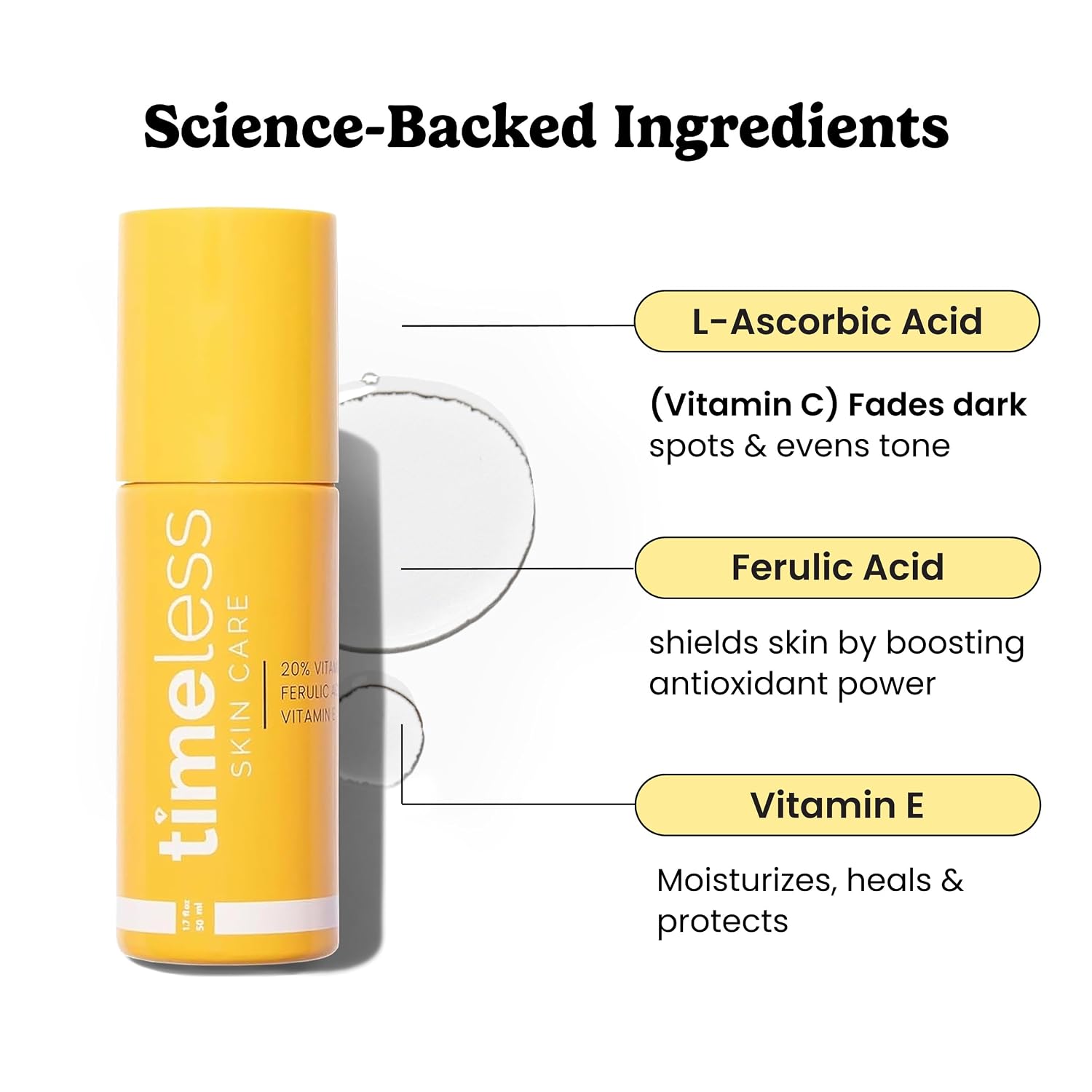
You pick up a vitamin C serum — the brightening, collagen-boosting kind you’ve been researching for weeks. It cost somewhere between $35 and $180. You start using it, and after two months of diligent morning applications, your skin looks… exactly the same. Sound familiar? There’s a good chance the formula degraded before it ever reached your face. Vitamin C, specifically the form called L-ascorbic acid (the gold-standard active ingredient in most brightening serums), is notoriously fragile. Exposure to air, light, heat, and even the wrong pH can convert it from a potent antioxidant into a useless — and sometimes irritating — oxidized compound. This article breaks down exactly how to tell, before you buy, whether a vitamin C serum is formulated to survive long enough to actually work.
If you’ve been in the skincare space for a year or more, you already know the category is crowded and the marketing is loud. This guide shifts the conversation from “which serum should I buy” to “how do I evaluate whether any serum is formulated correctly” — a skill that transfers across every price point, from a $15 drugstore bottle to a $182 clinical formula.
The Core Instability Problem: What’s Actually Happening in the Bottle
L-ascorbic acid (LAA) is the only form of vitamin C that penetrates skin in its active state. The research backing this is solid: the landmark 2001 study by Pinnell et al., published in Dermatologic Surgery and indexed on NCBI/PubMed, established that LAA must be formulated at a pH of 3.5 or below and at a concentration between 10% and 20% to absorb effectively. Below 10%, clinical benefit drops sharply. Above 20%, irritation climbs without proportional efficacy gains.
Here’s the tradeoff nobody prints on the label: the same low pH that makes LAA bioavailable (able to penetrate the skin barrier) also makes the formula chemically aggressive and prone to degradation. The moment the bottle is opened — and even before, if it’s been sitting in a warm warehouse — LAA begins oxidizing. Oxidized ascorbic acid turns the serum from clear or pale yellow to amber, orange, or brown. That color change isn’t cosmetic. It’s evidence the active is dead.
The three enemies of LAA stability, ranked by how quickly they act:
- Oxygen — the fastest killer. Every pump or dropper pull exposes the remaining product to air.
- UV light — accelerates oxidation dramatically. Clear glass packaging is essentially a solar accelerator.
- Heat — storage above roughly 25°C (77°F) meaningfully shortens shelf life, per formulation analysis published in Cosmetics & Toiletries.
The practical implication: a serum manufactured six months ago, shipped in a clear glass bottle, stored in a warm distribution center, and sitting on a shelf under retail lighting may have degraded significantly before you unseal it. This is what “dead on arrival” means — not hyperbole, just oxidation kinetics.
How to Read Packaging as a Stability Proxy
Packaging is your first due diligence checkpoint, and it’s available before you spend a dollar. Here’s the decision framework:
Opaque or amber glass > clear glass. Light-blocking packaging is a direct indicator that the brand formulated with stability in mind. SkinCeuticals C E Ferulic, consistently cited by Byrdie and Paula’s Choice Expert Advice as a benchmark formula, ships in an amber bottle specifically to block UV degradation. Clear glass is a red flag unless the brand has compensated with strong antioxidant synergists (more on that below).
Airless pump > dropper > open-mouth jar. Each step down this hierarchy increases oxygen exposure per use. An airless pump dispenses product without drawing air back into the reservoir. A dropper pulls air in with every squeeze-and-release cycle. A jar? You’re introducing oxygen and finger contamination with every application. No serious LAA formula should ever be in a jar — full stop. If you see one, walk away.
Vacuum-sealed or nitrogen-flushed. Some premium brands displace oxygen from the bottle interior during filling using inert nitrogen. This is a meaningful manufacturing investment and a positive signal. It’s rarely advertised prominently, but formulators and ingredient-literate reviewers sometimes surface this in technical writeups.
By the Numbers
| Packaging Type | Relative Oxygen Exposure | Stability Impact |
|---|---|---|
| Airless pump, opaque | Minimal | Best |
| Dropper, amber glass | Moderate | Acceptable |
| Dropper, clear glass | Moderate + UV risk | Caution |
| Open-mouth jar, any | High | Avoid for LAA |
Reading the INCI List: Stability Signals in the Formula Itself
INCI stands for International Nomenclature of Cosmetic Ingredients — it’s the standardized ingredient list you see on every cosmetic label, ordered by concentration from highest to lowest. For vitamin C serums, the INCI list tells you a lot about whether the brand engineered for stability.
Look for antioxidant synergists near the top of the list. The SkinCeuticals C E Ferulic formula is the most-studied example of this principle: it pairs L-ascorbic acid (15%) with tocopherol (vitamin E, 1%) and ferulic acid (0.5%). Research indexed on NCBI demonstrates that ferulic acid roughly doubles the photoprotection of the vitamin C + vitamin E combination while simultaneously stabilizing both actives against oxidation. When you see this triad — or partial versions of it — you’re looking at a formula engineered for longevity, not just label claims.
Other stabilizing additions to recognize on the INCI:
- Sodium ascorbyl phosphate (SAP) — a more stable LAA derivative. Less potent but far less volatile. If a formula uses SAP instead of LAA, it’s not the same molecule — understand the tradeoff before comparing prices.
- Ascorbyl glucoside — another stable derivative with some evidence of conversion to active ascorbic acid in skin. More suitable for sensitive skin; lower irritation profile.
- 3-O-ethyl ascorbic acid (3-OAA) — a newer derivative with improved stability and emerging evidence for melanin inhibition, per formulation analyses in Cosmetics & Toiletries. Appears in several mid-tier and premium Asian formulations.
- Propanediol or glycerin high on the list — humectants that buffer water activity and can slow oxidation reactions. A positive signal in an LAA formula.
What the INCI won’t tell you directly: exact pH. Brands aren’t required to list pH on the label. But if a formula contains LAA and also contains a high concentration of water-binding agents and antioxidant synergists, the formulation logic strongly implies the brand is working with pH deliberately. If you want confirmation, pH strips applied to a test drop of product will read acidic (ideally 2.5–3.5) in a well-formulated LAA serum. The American Academy of Dermatology’s patient-facing resources note that low-pH actives should be applied first in a routine, before moisturizers and SPF — which is consistent with proper LAA formulation.
The Derivative Decision: When LAA Isn’t the Right Call
Here’s the practitioner-level tradeoff that gets glossed over in most buying guides: LAA is not always the optimal choice for your client or your own routine, and reaching for a derivative isn’t a compromise — it’s sometimes the smarter formulation decision.
LAA at effective concentrations (10–20%) will sting or tingle on compromised, sensitized, or rosacea-prone skin. The pH required for efficacy is roughly equivalent to diluted vinegar. If a client is also using a retinoid, a prescription tretinoin, or a strong exfoliant, layering LAA creates a real irritation risk. In these cases, ascorbyl glucoside or 3-OAA offer meaningful antioxidant and brightening benefit with a far better tolerance profile.
The relevant decision framework:
- Intact barrier, not using actives that raise irritation risk, prioritizing clinical evidence: LAA at 10–20%, proper packaging, verified low pH. This is the SkinCeuticals C E Ferulic scenario — worth the price if formulation integrity is confirmed.
- Sensitized, reactive, or compromised barrier: Consider ascorbyl glucoside or 3-OAA derivatives. Paula’s Choice Expert Advice explicitly addresses this tradeoff, recommending derivatives for reactive skin types.
- Budget-conscious, early in a routine: Stable-derivative serums at $15–$35 consistently outperform oxidized premium LAA serums in any real-world cost-per-dose analysis. A degraded $80 serum delivers zero active benefit.
- Layering with prescription actives: Consult prescribing provider. Low-pH LAA and tretinoin should not be applied simultaneously without clinical guidance on spacing.
Healthline’s overview of vitamin C serum benefits notes that the ingredient category broadly has solid evidence for brightening and photoprotection support — but that evidence is specifically anchored to properly formulated and stable product. A serum that has oxidized provides no brightening benefit and may deposit oxidative stress rather than neutralizing it.
Practical Checklist Before You Buy (or Recommend)
Pull up the product page. Ask these questions in order:
- Is the active LAA or a derivative? Name it. Know the tradeoff.
- What is the concentration? Below 10% LAA is sub-clinical for most published efficacy endpoints.
- Is the packaging opaque or UV-blocking? Clear glass = automatic flag.
- Is the dispenser airless or nitrogen-sealed? Dropper is acceptable; jar is not.
- Are ferulic acid and/or vitamin E present in the INCI? Their presence signals formulation competence.
- What is the reported or estimated pH? If the brand won’t disclose and reviewers haven’t documented it, factor that opacity into your confidence level.
- What is the product’s supply chain velocity? A niche brand with low turnover on a third-party marketplace is higher oxidation risk than a high-velocity SKU shipped directly from the brand.
The cost-per-dose math only works if the dose is active. A $180 serum used correctly for 60 days at one daily pump costs $3 per application — excellent value if the formula is intact. The same serum, oxidized at purchase, costs infinity dollars per active dose, because there are none.
If X, Then Y: Decision Rules
If the packaging is clear glass and there’s no ferulic acid or tocopherol in the INCI: skip it regardless of price. Stability hasn’t been engineered in.
If you’re buying a premium LAA serum from a third-party seller or marketplace: confirm the seller is authorized and check the color before first use. Pale yellow is fine. Amber or orange means it’s already oxidized — return it.
If your skin is reactive or you’re active-stacking: choose a stable derivative (ascorbyl glucoside, 3-OAA) over LAA. The irritation you avoid is more valuable than the marginal potency difference.
If a drugstore serum is in proper opaque airless packaging with a documented pH under 3.5 and ferulic acid in the INCI: it will outperform a premium serum in compromised packaging. Every time. The chemistry doesn’t negotiate with branding.
The vitamin C serum category rewards the buyer who does fifteen minutes of INCI and packaging research more than almost any other skincare segment. The instability is real, the signals are readable, and the difference between a working formula and an oxidized one is available before you check out.