You’ve heard the advice a hundred times: start with a low concentration of retinol and work your way up. But if you’re still fuzzy on what “low” actually means in practice — or you’ve already burned your skin barrier by jumping in at the wrong rung — this guide is for you. Retinol is a form of vitamin A that speeds up how quickly your skin cells turn over (renewal cycle) and signals the deeper layers of skin to produce more collagen. It’s one of the most evidence-backed anti-aging ingredients available without a prescription. The catch: it’s also one of the most frequently misused, and the difference between “effective” and “irritating” often comes down to a single decimal point on the label. What follows is a clear framework for reading that label, matching concentration to your skin’s current state, and making an upgrade decision you won’t regret.
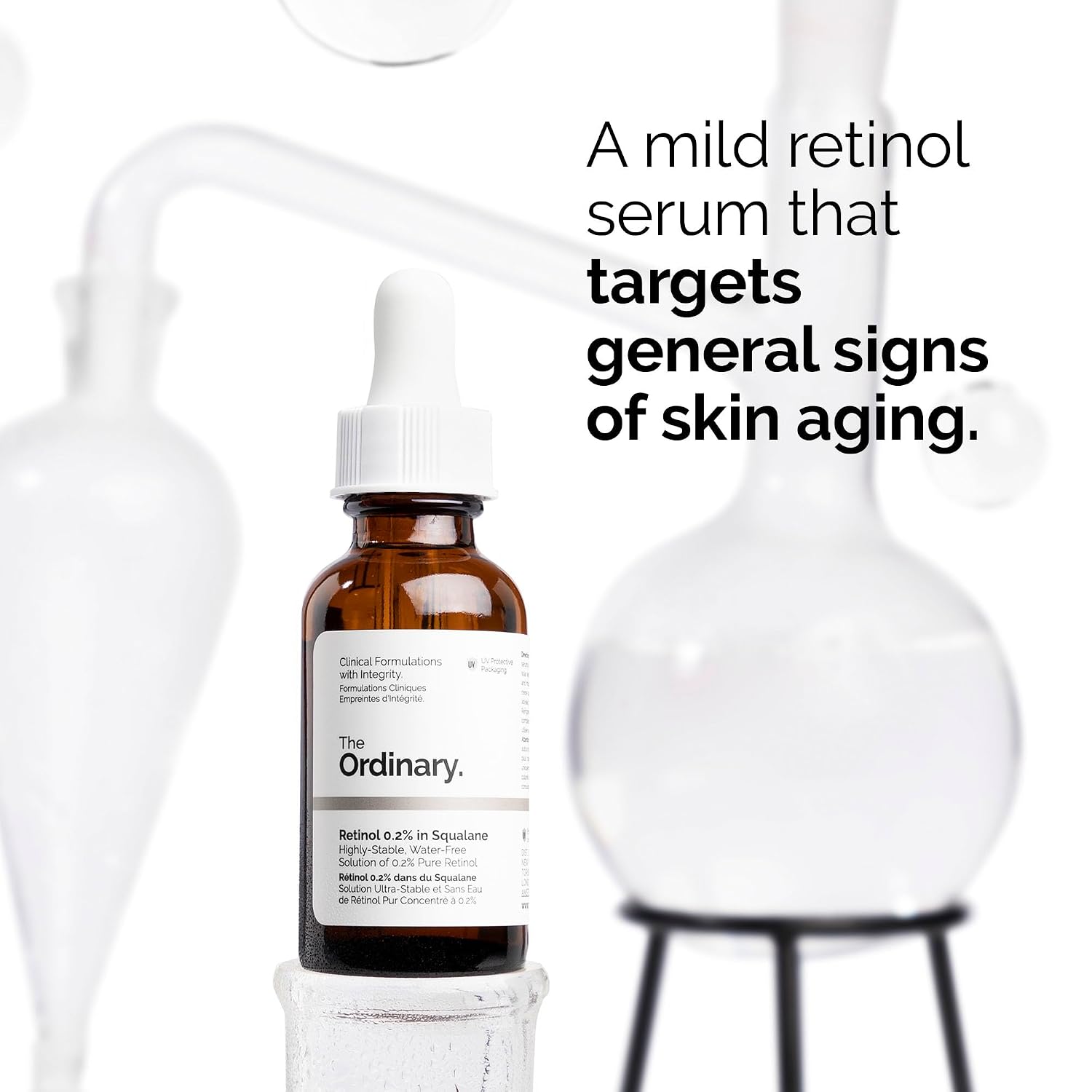
| EDITOR'S PICKPaula's Choice CLINICAL 1% Reti… | Mid-tier[The Ordinary Retinol 1% in Squa…](https://www.amazon.com/dp/B0779YGB2G?tag=greenflower20-20) | Budget pick[The Ordinary Retinol 0.2% in Sq…](https://www.amazon.com/dp/B0CZ5VG3L1?tag=greenflower20-20) | |
|---|---|---|---|
| Retinol % | 1% | 1% | 0.2% |
| Base Oil | — | Squalane | Squalane |
| Added Peptides | ✓ | ✗ | ✗ |
| Added Vitamin C | ✓ | ✗ | ✗ |
| Price | $65.00 | $9.90 | $8.10 |
| See on Amazon → | See on Amazon → | See on Amazon → |
Why Concentration Is Only Half the Equation
Here’s the decision frame most product labels won’t give you: retinol percentage and retinol delivered dose are not the same thing. A 0.3% retinol in a rich, occlusive cream base hits the skin very differently than 0.3% suspended in a lightweight water-serum — even if the front-of-label number is identical.
Three variables govern actual skin impact:
- Concentration — the percentage of retinol by weight in the formula
- Delivery system — emollients, encapsulation technology, and pH of the base all affect how fast retinol penetrates and how much reaches the dermis intact
- Frequency — three nights a week at 0.5% will produce less cumulative irritation than nightly use at the same concentration
The American Academy of Dermatology’s guidance on retinoids consistently emphasizes that irritation — redness, flaking, tightness — is a signal to slow the frequency, not necessarily to reduce the concentration. That’s a meaningful distinction when you’re deciding whether to step up or step back.
Paula’s Choice’s expert-advice library makes a complementary point: the skin’s retinization period (the 4–8 week window during which your barrier adjusts to regular retinol use) is real, and many people abandon a product that would have worked if they’d survived the adjustment phase. The error is misreading normal retinization as product failure.
The Four Rungs: A Practical Concentration Map
Think of the market in four bands. Every product recommendation you’ll encounter maps to one of these rungs, and your current skin state — not your ambition — determines where you belong right now.
Rung 1: 0.01%–0.1% — True Beginner Territory
This is the appropriate starting range if any of the following are true: you’ve never used a retinoid before; you have diagnosed rosacea or reactive skin; you’re postpartum or recently post-procedure; or you’re reintroducing retinol after a long break. At this concentration, most users experience minimal purging or flaking. The tradeoff is that visible results take longer — typically 12–16 weeks before improvements in fine lines or skin texture become measurable.
Products in this range include entry-level drugstore formulas and several “gentle” or “sensitive skin” retinol offerings. CeraVe Retinol Serum sits in this band, packaged in an opaque pump that protects the active from light degradation — a formulation detail worth noting, because retinol oxidizes on exposure to air and UV. Reviewers across Allure and Byrdie consistently highlight CeraVe’s ceramide-fortified base as a significant advantage at this rung: it buffers irritation while the skin acclimates.
Who it’s for: True newcomers, sensitive skin types, anyone recovering from barrier damage. Who it isn’t for: Anyone 6+ months into an established retinol routine expecting continued progress at this dose.
Rung 2: 0.2%–0.5% — The Productive Middle
This is where most skincare-engaged adults should spend the majority of their retinol “career.” The evidence base for visible anti-aging results — smoother texture, reduced hyperpigmentation, measurable increase in collagen markers — is strongest in published literature at concentrations in this range. Healthline’s overview of retinol clinical evidence notes that studies documenting clear efficacy have frequently used 0.25% to 0.5% formulations applied consistently over 12–24 weeks.
RoC Retinol Correxion sits at the lower end of this band and has a long real-world track record in consumer reviews for delivering visible results with manageable irritation. At the mid-to-upper end, The Ordinary’s 0.5% in Squalane offers a stripped-down, price-transparent formula — no frills, reliable delivery, and a cost-per-dose that’s essentially impossible to beat for the concentration.
The upgrade trigger to watch for: If you’ve been consistent at 0.2%–0.3% for 3+ months with zero irritation and results have plateaued, moving to 0.5% is a defensible next step. If you’re still experiencing occasional flaking at 0.3%, do not interpret that as a reason to step up. Increase frequency first — go from twice-weekly to three times weekly — before changing concentration.
Who it’s for: Anyone past the 8-week retinization window who wants measurable, not just theoretical, results. Who it isn’t for: Skin that hasn’t yet completed the adjustment cycle, or anyone using concurrent strong actives (daily AHAs, benzoyl peroxide) without a sequenced routine.
Rung 3: 0.5%–1% — Performance Territory
At this rung, you’re in the range where over-the-counter retinol begins to approach the lower end of prescription retinoid territory in terms of visible impact — but without the prescription’s price barrier or the regulatory constraints on formulation. This is where ingredients like Paula’s Choice 1% Retinol Treatment operate, and where the formulation decisions made by the brand start to matter enormously.
A 1% retinol in a poorly stabilized formula — thin texture, clear jar packaging, no antioxidant support — will deliver more irritation and less actual retinol to the dermis than a 0.5% formula in a sophisticated encapsulated delivery system. Paula’s Choice’s expert-advice team has published extensively on why packaging matters: retinol in a jar with repeated air exposure degrades measurably within weeks of opening, reducing effective concentration at the point of use.
By the numbers:
- 0.5% retinol, nightly use: ~$0.30–$0.60/dose at mid-market price points
- 1% retinol (Paula’s Choice): ~$1.10–$1.40/dose
- 1% retinol (luxury tier, e.g., SkinCeuticals 0.3% Retinol — note: SkinCeuticals formulates conservatively by design): $2.00+/dose
- Prescription tretinoin 0.025% (Rx, generic): ~$0.10–$0.20/dose where accessible
That cost-per-dose spread deserves honest scrutiny before you commit to the top of the OTC ladder.
Who it’s for: Established retinol users (6+ months consistent use at Rung 2), those targeting visible signs of photoaging or persistent hyperpigmentation, and anyone whose dermatologist has confirmed their skin can handle higher concentrations. Who it isn’t for: Anyone who hasn’t earned their tolerance at lower rungs, or who is simultaneously using prescription-strength actives without guidance.
Rung 4: Above 1% OTC / Prescription Retinoids — The Clinical Zone
Above 1% in the OTC market, you’re largely in specialty territory — often time-release or encapsulated systems designed to blunt the irritation that raw high-concentration retinol would otherwise cause. Brands operating here (Medik8, Environ, and some medical-spa-exclusive lines) typically sell through licensed practitioners for a reason: the margin for formulation error is narrow.
Prescription tretinoin (retinoic acid — the already-converted, active form that doesn’t require the skin’s own conversion step that retinol does) operates outside the OTC ladder entirely. It is categorically more potent milligram-for-milligram than retinol because it skips the conversion pathway. Byrdie’s retinol guide makes this pharmacological distinction clearly: retinol must convert to retinaldehyde, then to retinoic acid in the skin — a process that attenuates potency and irritation simultaneously. Tretinoin arrives already at the final step.
If you’re at this rung, the cost-per-dose math often flips in favor of Rx: generic tretinoin, where accessible, is among the most cost-efficient high-efficacy options in all of skincare. The barrier is access and tolerability, not value.
Who it’s for: Patients under dermatologist supervision, aesthetic-adjacent professionals managing their own skin with clinical knowledge, and long-term retinoid users managing specific conditions (acne, significant photoaging) rather than general maintenance. Who it isn’t for: Anyone self-directing without baseline experience at OTC concentrations — and anyone who hasn’t addressed barrier health first.
How to Make the Upgrade Decision Without Burning Your Barrier
The most useful decision framework isn’t “how much retinol can I tolerate” — it’s “what does my skin need that my current rung isn’t delivering?” Those are different questions.
If X, then Y:
- If you have zero irritation at your current concentration after 12+ weeks: Consider stepping up one rung or increasing frequency before concentration. Frequency is the lower-risk lever.
- If you have intermittent mild flaking: Hold concentration, optimize frequency, and add a barrier-support ingredient (niacinamide, ceramides, a plain occlusive) on off nights.
- If you have persistent redness or stinging beyond week 8: Step down one rung, or consider whether your overall routine has too many actives competing for barrier tolerance.
- If results have plateaued entirely and you’re at 0.5%–1% OTC: This is a reasonable inflection point to consult a dermatologist about prescription options rather than chasing higher OTC concentrations.
- If you’re layering retinol with AHAs, BHAs, or vitamin C daily: The concentration ladder matters less than the interaction stack. Per Allure’s formulation coverage, alternating actives on different nights reduces cumulative irritation more reliably than choosing a lower retinol percentage and stacking everything on the same night.
One formulation detail that rarely gets enough attention at the practitioner level: packaging signals stability commitment. Opaque pump dispensers and airless bottles indicate the brand is protecting retinol from its primary enemies — light and oxygen. A clear jar with a wide opening is a formulation red flag at any concentration. This is not a marketing distinction; it’s a shelf-life and cost-per-effective-dose issue that compounds over the 2–4 months a typical bottle takes to use.
The Bottom Line
The retinol ladder isn’t about ambition — it’s about matching the active to the skin you have today, not the skin you want six months from now. Most people who experience retinol failure did so because they started too high, moved up too fast, or stacked too many actives without accounting for cumulative load on the barrier. The evidence-backed path is methodical and, honestly, a little boring: pick the right rung, stay consistent for 12 weeks, evaluate results against irritation, and earn the next step.
Start where your skin is. The ladder goes up from there.