You’ve probably seen the price range and wondered whether you’re just paying for packaging. Retinol is one of the most studied actives in skincare — a vitamin A derivative (meaning it’s chemically related to vitamin A) that, once absorbed by skin, converts into retinoic acid, the form that signals cells to turn over faster, stimulate collagen production, and fade uneven tone. The research behind it is genuinely strong: a foundational review published in Clinical Interventions in Aging by Mukherjee et al. confirmed that topical retinoids produce measurable structural changes in aging skin. The catch is that “retinol serum” describes everything from a $8 dropper bottle to a $180 prestige formula — and the sticker price almost never tells you what the monthly cost or the real clinical value actually is. This guide breaks down the math across five price tiers, names the variables that actually drive efficacy, and ends with a decision framework you can apply to whatever is currently in your cart or on your comparison spreadsheet.
Why Cost-Per-Bottle Is the Wrong Metric
The number on the shelf tells you what you’ll pay at checkout. It doesn’t tell you:
- How many doses are in the bottle (a 1 oz / 30 mL bottle at the standard two-pea-sized-drop application gives roughly 90 nightly applications — about three months for a PM-only user; some premium products ship in 15–20 mL formats)
- What concentration of retinol (the actual percentage of the active ingredient) is present — a 0.025% formula and a 1% formula are not clinically equivalent starting points
- Packaging stability — retinol oxidizes on contact with light and air, which degrades the active before it reaches your skin; opaque, airless pump packaging preserves potency meaningfully longer than a clear dropper bottle, per formulation analysis cited in Allure’s deep-dive on retinol storage and shelf life
- The vehicle — what the retinol is suspended in affects both penetration and tolerance; a squalane-based formula behaves differently on a disrupted barrier than a water-serum base
The American Academy of Dermatology’s consumer FAQ on retinoids notes that “percentage matters, but so does the delivery system and how the product is formulated around the active.” That’s a practitioner-level nuance most price comparisons skip entirely.
The Five-Tier Math, Laid Out
Let’s run actual cost-per-month numbers across the major market tiers. Assumptions: one nightly application, ~0.3–0.5 mL per use, standard 30 mL bottle unless noted. All pricing reflects 2026 US market averages.
By the Numbers
| Product | Size | Retail | Est. Doses | Cost/Month |
|---|---|---|---|---|
| The Ordinary Retinol 0.5% in Squalane | 30 mL | ~$8 | ~90 | ~$2.70 |
| CeraVe Resurfacing Retinol Serum | 30 mL | ~$22 | ~90 | ~$7.30 |
| RoC Retinol Correxion Line Smoothing Serum | 30 mL | ~$26 | ~90 | ~$8.70 |
| Paula’s Choice 1% Retinol Treatment | 30 mL | ~$65 | ~90 | ~$21.70 |
| SkinCeuticals Retinol 1.0 | 30 mL | ~$108 | ~90 | ~$36.00 |
The range isn’t $8 to $108. It’s $2.70/month to $36/month. That reframe matters when you’re deciding whether to upgrade.
What You’re Actually Buying as You Move Up the Tiers
Budget Tier ($2–$9/month): The Ordinary and the Drugstore Anchors
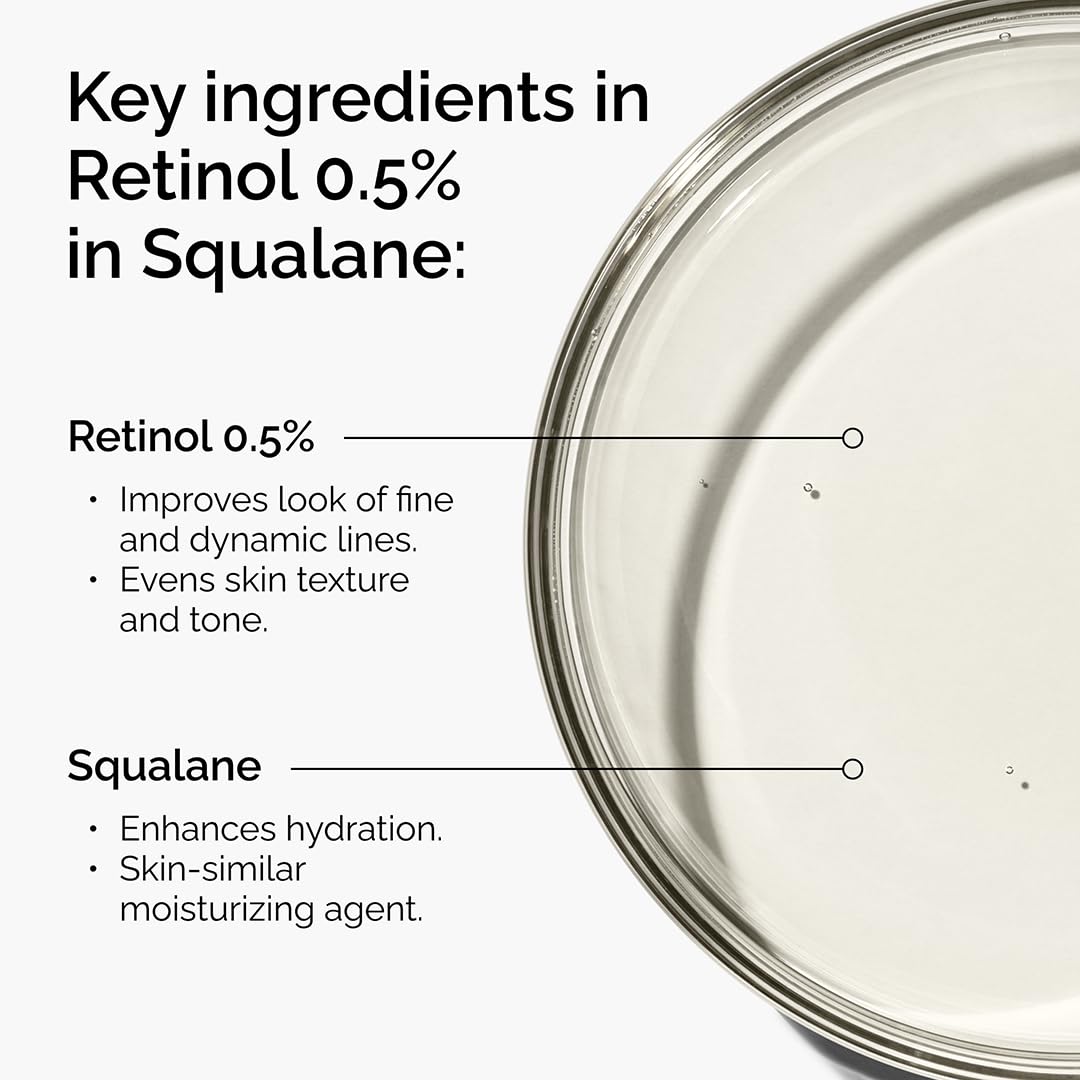
The Ordinary’s Retinol 0.5% in Squalane is the canonical entry point for evidence-curious beginners and cost-optimizing intermediate users. The published formulation is transparent: 0.5% retinol in a squalane base, opaque packaging, no silicones to interfere with penetration. Reviewers at Byrdie consistently note that the texture is minimal and that the squalane base makes it more tolerable than water-based budget alternatives. The trade-off is that The Ordinary’s airless pump situation has historically been inconsistent across SKUs — some versions ship in a dropper, which exposes the formula to air and light more readily than an airless system would.
CeraVe’s entry mixes retinol with niacinamide (a vitamin B3 derivative that supports barrier function) and hyaluronic acid (a humectant — a molecule that draws water to skin). For someone whose barrier is compromised or who is retinol-naive (meaning they haven’t used it before and are starting carefully), that formulation stack offers built-in buffering. The cost-per-month at ~$7.30 is competitive for what the formula includes. The retinol concentration isn’t disclosed on the label — a common drugstore limitation that Healthline’s overview of retinol identifies as a consumer transparency gap across the category.
Who this tier is for: First-year users building tolerance, anyone with a disrupted barrier who needs a gentler entry, cost-per-month-sensitive routines, or anyone stacking multiple actives who doesn’t want to over-invest before confirming retinol fits their stack.
Who it isn’t for: Anyone needing a verified 0.5%+ concentration for clinical endpoints like texture refinement or hyperpigmentation; users who need airless packaging integrity for a warm-climate or bathroom-cabinet storage situation.
Mid Tier ($8–$22/month): RoC and the Drugstore Premium Band
RoC’s Retinol Correxion line has decades of published consumer-outcome data behind it and genuine brand equity in the clinical space. The formula runs at a lower retinol concentration than its label positioning implies, but the encapsulated retinol delivery system (a technology where retinol is wrapped in a microscopic capsule that releases slowly on skin contact) reduces irritation and may improve delivery stability — a formulation note that Paula’s Choice’s Expert Advice section calls out as meaningful for sensitive-skin users who have previously reacted to direct-suspension retinol.
Tradeoff to name explicitly: Encapsulated retinol systems make comparing concentrations almost impossible across brands. A 0.3% encapsulated formula and a 0.3% direct-suspension formula do not deliver equivalently, but there’s no standardized consumer-facing label disclosure for that — a gap the AAD and formulation researchers have flagged repeatedly without resolution.
Upper-Mid Tier ($15–$22/month): Paula’s Choice 1% Retinol Treatment
This is the most defensible choice in the mid-to-premium crossover for an intermediate user who has already completed a tolerance-building phase. Paula’s Choice publishes its concentration (1%), discloses the vehicle (a serum base with antioxidants including vitamin C ester), and the brand’s Expert Advice team has documented the rationale for pairing retinol with peptides for synergistic collagen support. Reviewers across Byrdie and Allure consistently place this formula in the top tier for users who want clinical performance without prestige pricing.
The math argument for this tier over budget: The delta from The Ordinary to Paula’s Choice 1% is roughly $19/month — less than a single restaurant lunch. The concentration delta (0.5% vs. 1%) and the packaging integrity represent a meaningful efficacy difference for a user already past tolerance-building. The cost-per-month frame makes that tradeoff legible in a way the sticker price doesn’t.
Who it’s for: Users 6+ months into retinol use, those targeting visible texture, fine lines, or post-acne hyperpigmentation with a verified 1% dose.
Who it isn’t for: Retinol-naive users; those with active barrier disruption who need a lower starting concentration.
Prestige Tier ($30–$45+/month): SkinCeuticals and the Clinical Premium Band
SkinCeuticals Retinol 1.0 runs at the same listed concentration as Paula’s Choice but in a different vehicle and with a formulation architecture that includes the brand’s antioxidant stabilization system. The price premium at ~$36/month vs. ~$22/month is real. The honest analysis: reviewers in aggregated long-run reviews (Byrdie’s updated 2025–2026 roundups include this tier) note that the SkinCeuticals formula produces comparable outcomes for most users, but that the packaging — an airless pump — and the brand’s clinical provenance make it the standard recommendation in medical spa retail environments where product integrity under variable storage conditions is a practical concern.
The practitioner frame: If you are recommending products in a clinical or aesthetic-adjacent setting, the prestige tier’s brand legitimacy and clinical literature trail carry soft value beyond the formula itself. If you are a solo buyer optimizing for personal use, that value evaporates and the Paula’s Choice math is hard to argue against.
The Variables That Can Flip the Math
Packaging: An open dropper bottle exposes retinol to air and light at every use. If your budget formula degrades by month two, your effective cost-per-dose jumps significantly. Airless pumps — standard on Paula’s Choice and SkinCeuticals, inconsistent at the budget tier — matter practically, not just theoretically.
Concentration stacking: Using a 0.025% formula every night is not equivalent to using a 0.5% formula three nights per week. Healthline’s retinol overview notes that frequency and concentration interact — a higher-concentration, lower-frequency protocol often produces equivalent clinical outcomes with lower irritation than a low-concentration daily one. That affects how quickly you consume a bottle and therefore your real monthly cost.
Buffer products: If a budget retinol formula drives you to also purchase a barrier-repair serum or a rich moisturizer to manage irritation, the system cost is higher than the line-item cost suggests. A well-formulated mid-tier product with built-in buffering ingredients (niacinamide, squalane, peptides) may actually reduce total routine spend.
The Decision Framework
If you are in the first 0–6 months of retinol use: Start at the budget-to-low-mid tier (The Ordinary or CeraVe). The concentration is appropriate, the cost-per-month risk is low while you assess tolerance, and the clinical outcome ceiling is sufficient for early-phase users. Prioritize airless or opaque packaging over brand prestige.
If you have 6–18 months of retinol experience and have cleared the tolerance threshold: The jump to Paula’s Choice 1% or a comparable verified-concentration mid-tier formula is financially justified by the delta in active dose alone. The $19/month difference buys a meaningful concentration upgrade and better packaging integrity.
If you are recommending products in a professional or aesthetic-adjacent context: The prestige tier (SkinCeuticals and above) offers brand legitimacy and clinical provenance that has soft value in that context. The formula delta over a well-run mid-tier product is modest; the brand-trust delta is real and worth pricing in.
If you are already in the prestige tier and wondering whether to stay: Run the buffer math. If you are not experiencing tolerance issues, not dealing with packaging degradation, and not in a professional recommendation context, the case for the $14/month premium over Paula’s Choice 1% is weak on formulation grounds alone. If brand provenance, clinical literature, and medical-spa context matter to your specific situation, it earns its keep.
The math is clean. The decision is yours — but now you have the frame to make it in the register of cost-per-month rather than sticker shock in either direction.