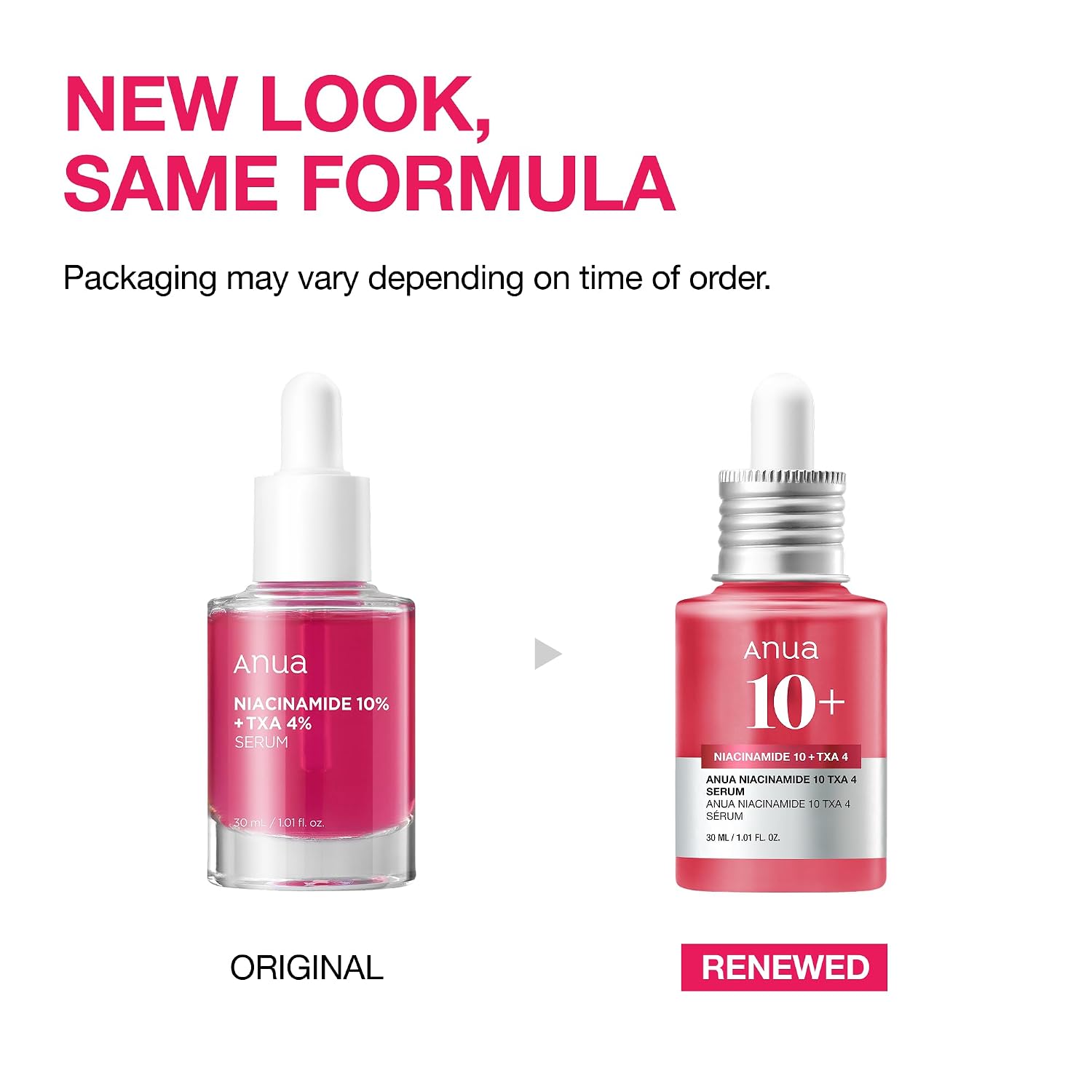
You’ve been dealing with dark spots — maybe left over from a breakout, maybe melasma along your cheekbones, maybe just an uneven tone you can’t seem to move — and you’ve probably already scrolled through enough ingredient lists to know that vitamin C, kojic acid, and retinol all get mentioned as brighteners. But two ingredients keep showing up together in formulas that dermatologists and aestheticians actually recommend: niacinamide (a form of vitamin B3 that interrupts the process by which dark pigment travels to the skin’s surface) and tranexamic acid (often abbreviated TXA — a compound originally used in medicine to control bleeding that, at lower topical concentrations, blocks a separate step in the same pigment-production pathway). The reason practitioners like stacking them is that they attack hyperpigmentation — the umbrella term for any patches of skin that are darker than surrounding tissue — through different mechanisms simultaneously. This article breaks down the science, the layering logic, and the specific products worth your money at every budget tier, with honest tradeoffs at each step.
| EDITOR'S PICKPaula's Choice CLINICAL 20% Nia… | Mid-tierL’Oréal Paris Bright Reveal 12%… | Budget pick[The Ordinary Niacinamide 10% +…](https://www.amazon.com/dp/B0DP1GMQK4?tag=greenflower20-20) | |
|---|---|---|---|
| Niacinamide % | 20% | 12% | 10% |
| Key Additives | — | Amino Sulfonic + Ferulic | Zinc 1% |
| Size (fl oz) | 0.67 | 1 | 1 |
| Fragrance-Free | ✓ | — | — |
| Target Concern | Discoloration / Pores | Dark spots | Blemishes |
| Price | $55.00 | $31.99 | $6.00 |
| See on Amazon → | See on Amazon → | See on Amazon → |
Why This Stack Works: Two Mechanisms, One Target
Hyperpigmentation is ultimately a melanin-overproduction problem. Melanin (the pigment that gives skin its color) is synthesized in cells called melanocytes, packaged into structures called melanosomes, and then transferred to surrounding skin cells. Darks spots form when that process goes into overdrive — triggered by UV exposure, hormonal shifts, inflammation from acne, or a combination of all three.
Niacinamide doesn’t block melanin synthesis at the source. Instead, research published in the British Journal of Dermatology by Hakozaki et al. (2002) established that it interrupts melanosome transfer — essentially blocking the handoff of pigment packets from melanocytes to keratinocytes (the cells that make up the outer skin layer). The same paper showed statistically significant reductions in hyperpigmentation at concentrations as low as 2%, with stronger results at 5%. That’s a meaningful data point: a lot of well-formulated over-the-counter products clear that bar.
Tranexamic acid works upstream. It inhibits the interaction between keratinocytes and melanocytes by blocking a receptor pathway that UV light and inflammation use to signal “make more melanin.” A review in the Journal of Cosmetic Dermatology by Tse and Hui (2013) documented its effectiveness for melasma — one of the most stubborn pigmentation presentations — both orally and topically, with topical concentrations in the 2–5% range showing clinically measurable results without the systemic side-effect profile of oral dosing. Byrdie’s overview of tranexamic acid for skin notes it has become a go-to recommendation from dermatologists specifically because its tolerability profile is unusually clean — minimal irritation, compatible with sensitive skin, no mandatory sun-avoidance requirement the way some actives carry.
The stack logic: Niacinamide handles the transfer step. TXA handles the upstream signaling step. Use both and you’re running a two-front approach against the same target. Neither ingredient is photosensitizing, neither requires an acid-adjusted pH to function, and they’re generally non-reactive with each other — which makes the layering calculus simpler than, say, managing a vitamin C + AHA combination.
By the Numbers
| Ingredient | Effective Topical Concentration | Key Mechanism | Photosensitizing? |
|---|---|---|---|
| Niacinamide | 2–10% (sweet spot: 5%) | Blocks melanosome transfer | No |
| Tranexamic Acid | 2–5% | Inhibits UV/inflammation → melanin signaling | No |
| Vitamin C (L-AA) | 10–20% | Antioxidant; inhibits tyrosinase enzyme | No, but oxidizes easily |
| Kojic Acid | 1–4% | Tyrosinase inhibitor | No |
The takeaway: niacinamide and TXA are two of the most formulation-friendly brighteners on the market. That friendliness translates to real-world consistency — they survive in a wider range of packaging and formula types than vitamin C, and they layer without the pH-juggling that AHA-and-vitamin-C stacking demands.
Building the Routine: Layer Order, Timing, and What to Combine
Paula’s Choice Expert Advice on product layering establishes the general rule: thinner, water-based formulas before thicker, oil-based ones. For a brightening stack, the practical sequence looks like this:
Morning (the protective layer):
- Gentle cleanser
- Niacinamide serum or toner (water-based, applies thin)
- Moisturizer (optionally one that contains TXA, so you’re doubling up)
- SPF 30–50 — non-negotiable; the American Academy of Dermatology’s hyperpigmentation treatment guidance explicitly states that UV protection is the single most important factor in preventing new spots and allowing actives to do their work without interference
Evening (the treatment layer):
- Gentle cleanser
- TXA serum (higher concentration, dedicated treatment step)
- Niacinamide moisturizer or a combined moisturizer
- Optional: retinol 2–3× per week on alternating nights (retinol accelerates cell turnover, helping the skin shed pigmented cells faster — but it needs its own on-ramp, so phase it in slowly)
The timing question most people get wrong: You don’t need to wait 20–30 minutes between these two ingredients the way you would with a low-pH vitamin C followed by a higher-pH moisturizer. Niacinamide and TXA are both pH-flexible. Apply one, let it absorb for 60–90 seconds until the skin no longer feels wet, then layer the next. That’s it.
The niacinamide + vitamin C question: Older formulation lore warned that niacinamide and vitamin C combined to form niacin (nicotinic acid), causing flushing. Healthline’s niacinamide overview addresses this directly — the conversion requires high-temperature conditions that don’t exist on skin at room temperature, and modern stabilized vitamin C formulas make it a non-issue in practice. You can use both; just put vitamin C first if you’re combining them in the same routine, since it wants the slightly more acidic environment closest to the skin surface.
Product Picks: Entry, Mid-Tier, and Premium
Entry tier ($10–$30): The Ordinary Niacinamide 10% + Zinc 1% is arguably the most widely reviewed brightening serum in this price range — aggregated reviews consistently flag visible improvement in uneven tone with 8–12 weeks of consistent use. The zinc addition makes it particularly useful if your hyperpigmentation is post-acne. For TXA at entry tier, The Inkey List Tranexamic Acid Night Treatment delivers a 2% TXA concentration in an accessible leave-on formula designed for nightly use.
Who entry tier is for: First-time brightening routines, anyone patch-testing to confirm tolerability before committing higher budgets, or someone building toward a more comprehensive stack and wanting to establish a baseline.
Who it’s not for: Melasma that has persisted for 12+ months or deep dermal pigmentation — entry concentrations will show some movement, but the timeline will be long and the ceiling lower.
Mid-tier ($25–$80): Paula’s Choice 10% Niacinamide Booster is the mid-tier benchmark — a concentrated, fragrance-free formula with a well-documented stable formulation. Paula’s Choice Expert Advice documentation on the product is unusually transparent about its ingredient-level rationale, which is useful if you’re building client recommendations and need to back your reasoning. For TXA at this tier, Good Molecules Discoloration Correcting Serum (approximately $12, but formulated at a meaningful 3% TXA concentration with added kojic acid and niacinamide) punches significantly above its price point. It’s an outlier worth flagging: the cost-per-dose math on this formula is among the most favorable in the category.
Who mid-tier is for: Anyone who has confirmed ingredient tolerability at entry tier and wants to step up concentration, or clients maintaining results rather than chasing aggressive correction.
Premium ($80–$200+): SkinCeuticals Discoloration Defense is the category reference product — a 3% TXA, 1% kojic acid, 5% niacinamide combination formula that represents one of the few premium SKUs with a multi-ingredient brightening stack in a single bottle. Byrdie’s coverage of tranexamic acid products repeatedly cites it as the clinical-grade standard against which other topical TXA formulas are compared. At approximately $98–$108 for 30mL, the cost-per-dose is high, but the formulation stability (dark glass, tight pH control) and the ingredient concentration stack justify the premium for clients who want maximum efficacy in a single product rather than managing a two-bottle stack.
At the true luxury tier, Sisley Paris Intensive Serum with Tropical Resins and Caudalie Vinoperfect Radiance Serum both incorporate brightening actives in sophisticated delivery systems, though neither is primarily a TXA vehicle — they’re worth knowing for clients who prioritize luxury experience alongside results, but they’re not the most efficient route to the same brightening endpoints if ingredient efficacy is the primary criterion.
Who premium is for: Clients with persistent melasma, significant post-inflammatory hyperpigmentation (PIH), or those who want the convenience of a clinically formulated single product over a DIY stack.
Who it’s not for: Anyone still in the tolerance-testing phase, or a budget-conscious routine where the Good Molecules combination product delivers meaningfully comparable active concentrations at a fraction of the cost.
The Decision Framework
If you’re advising a client or calibrating your own routine, work through these in order:
If the pigmentation is primarily post-acne PIH on a budget: Start with The Ordinary Niacinamide 10% + Zinc AM and The Inkey List TXA treatment PM. Expect visible change at 8–10 weeks. Add SPF as a non-negotiable anchor.
If the pigmentation is melasma or UV-driven with at least 6 months of history: Go directly to mid or premium tier. Good Molecules Discoloration Correcting Serum is the best-value single product in this category. SkinCeuticals Discoloration Defense is the right call if your client has disposable budget and wants a clinician-grade, single-bottle protocol they’ll actually use consistently.
If you’re already running retinol in the routine: Keep retinol on alternating nights, TXA on the other nights, niacinamide every morning. Don’t layer TXA directly on top of a fresh retinol application the same evening — give the retinol nights their own lane, since the goal is to let each active do its primary job without skin barrier overload.
If there’s been no improvement after 12 weeks of consistent use with a mid-tier stack: That’s the referral signal. The American Academy of Dermatology’s hyperpigmentation guidance notes that deep dermal melasma in particular often requires prescription-level intervention — hydroquinone at 4%, combination formulas like tri-luma (fluocinolone acetonide + hydroquinone + tretinoin), or in-office procedures — and a topical OTC stack, no matter how well formulated, has a ceiling. Knowing that ceiling and communicating it clearly is part of the practitioner value-add.
The brightening category is genuinely crowded with products that promise more than they can deliver. Niacinamide and tranexamic acid have the evidence base, the tolerability profile, and the formulation flexibility to anchor a serious hyperpigmentation routine. The stack works — the variable is whether the concentration, consistency, and timeline expectations are aligned with the depth of the problem you’re trying to solve.